BREAKING NEWS
latest

728x90

468x60

Celebrity News

Celebrity/block-6

Mastering the Art of Persuasion: A Guide to Writing Compelling Persuasive Essays

how to write a persuasive essay


A persuasive essay is a type of essay that tries to convince the reader to agree with the writer's point of view. In order to write a persuasive essay, you need to choose a topic that you are passionate about and that you have strong opinions about. You also need to do your research and gather evidence to support your arguments.


Here are some tips on how to write a persuasive essay:


1. Choose a topic that you are passionate about.

This will make the writing process more enjoyable and easier to stay focused. If you are not interested in the topic, it will be difficult to write a well-informed and engaging essay.


2. Do your research.

Once you have chosen a topic, it is important to do your research. This will help you to gather evidence to support your thesis statement and to develop your arguments. You can find information on your topic in a variety of sources, including books, articles, websites, and interviews.


3. Create an outline.

An outline will help you to organize your thoughts and to ensure that your essay flows smoothly. The outline should include an introduction, body paragraphs, and a conclusion.


4. Write a strong introduction.

The introduction should grab the reader's attention and introduce the topic of your essay. You can do this by asking a question, telling a story, or providing a statistic.


5. Write clear and concise body paragraphs.

Each body paragraph should support one main point. The main point should be stated in a topic sentence, and the rest of the paragraph should provide evidence to support the topic sentence.


6. Write a strong conclusion.

The conclusion should restate your thesis statement and summarize the main points of your essay. You can also use the conclusion to leave the reader with something to think about.


7. Edit and proofread your essay.

Once you have finished writing your essay, it is important to edit and proofread it carefully. This will help you to catch any errors in grammar, spelling, or punctuation.


Here are some additional tips for writing a persuasive essay:


  • Use strong verbs and vivid language.
  • Avoid clichés and overused phrases.
  • Be specific and avoid vague language.
  • Use transition words to connect your ideas.
  • Cite your sources correctly.

By following these tips, you can write a persuasive essay that will inform and engage your reader.


Here are some additional tips for writing a persuasive essay:


Choose a strong thesis statement. Your thesis statement should be a clear and concise statement of your main argument. It should be something that you can argue for and support with evidence.

Use evidence to support your claims. Don't just state your opinion; back it up with evidence from credible sources. This could include statistics, expert opinions, or personal anecdotes.

Address opposing viewpoints. It's important to acknowledge and address any opposing viewpoints on your topic. This will show that you've thought critically about the issue and that you're not just trying to push your own agenda.

Be persuasive. Your goal is to convince your reader to agree with you. Use strong language and persuasive techniques to get your point across.

Proofread your work carefully. Before you submit your essay, be sure to proofread it for any errors in grammar, spelling, or punctuation.

By following these tips, you can write a persuasive essay that will be both informative and convincing.

Mastering the Art of Writing a Stellar Essay: Expert Tips and Strategies!

How to write a good essay?


Here are some unique and long answers on how to write a good essay:


1. Choose a topic that you are interested in.


This will make the writing process more enjoyable and easier to stay focused. If you are not interested in the topic, it will be difficult to write a well-informed and engaging essay.


2. Do your research.


Once you have chosen a topic, it is important to do your research. This will help you to gather evidence to support your thesis statement and to develop your arguments. You can find information on your topic in a variety of sources, including books, articles, websites, and interviews.


3. Create an outline.


An outline will help you to organize your thoughts and to ensure that your essay flows smoothly. The outline should include an introduction, body paragraphs, and a conclusion.


4. Write a strong introduction.


The introduction should grab the reader's attention and introduce the topic of your essay. You can do this by asking a question, telling a story, or providing a statistic.


5. Write clear and concise body paragraphs.


Each body paragraph should support one main point. The main point should be stated in a topic sentence, and the rest of the paragraph should provide evidence to support the topic sentence.


6. Write a strong conclusion.


The conclusion should restate your thesis statement and summarize the main points of your essay. You can also use the conclusion to leave the reader with something to think about.


7. Edit and proofread your essay.


Once you have finished writing your essay, it is important to edit and proofread it carefully. This will help you to catch any errors in grammar, spelling, or punctuation.


Here are some additional tips for writing a good essay:


  • Use strong verbs and vivid language.
  • Avoid clichés and overused phrases.
  • Be specific and avoid vague language.
  • Use transition words to connect your ideas.
  • Cite your sources correctly.

By following these tips, you can write a good essay that will inform and engage your reader.

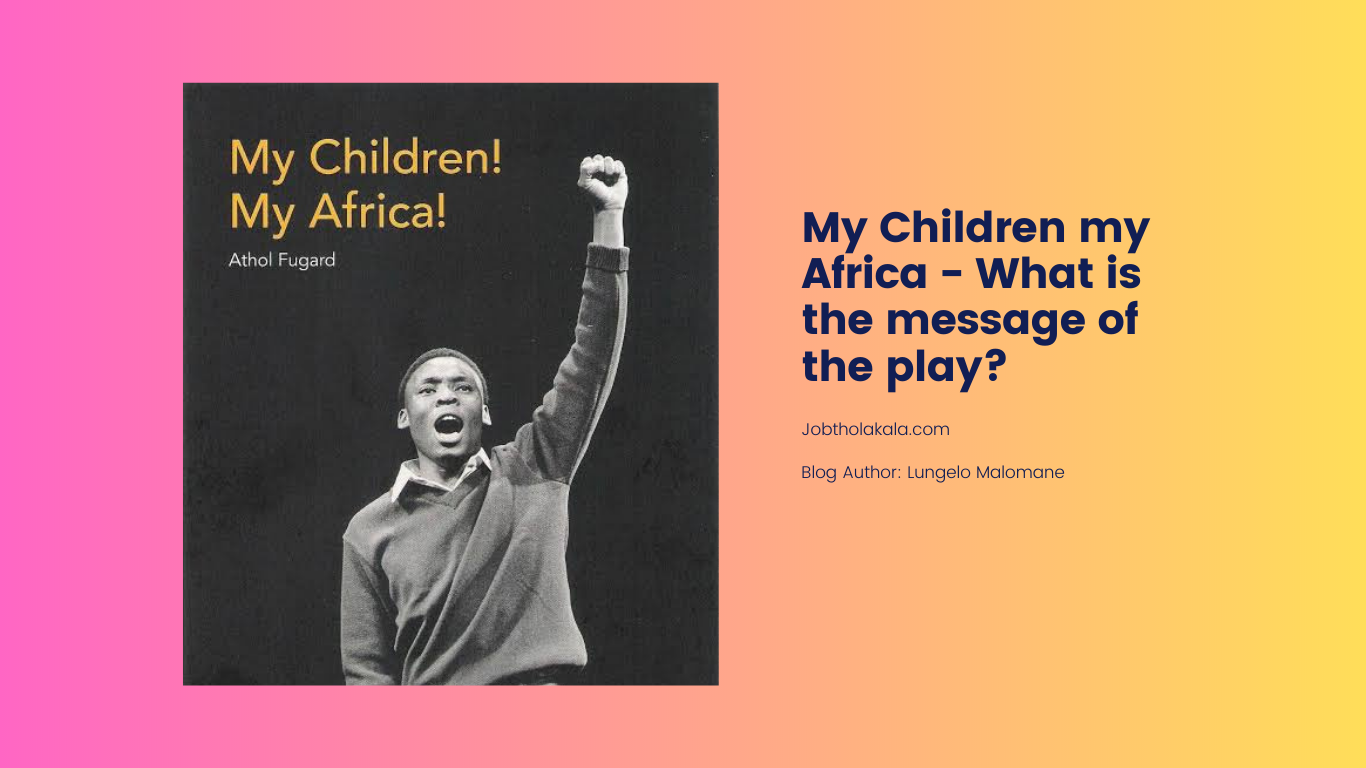
My Children my Africa - What is the message of the play?

My Children my Africa - What is the message of the play?


The message of the play "My Children! My Africa!" is that education is the key to a better future for all people. The play shows how education can be used to empower people, challenge the status quo, and build a more just and equitable world.


The play also shows how education can be used to overcome divisions and find common ground. Mr. M and Isabel, for example, are able to connect with each other despite their different races. They share a love of learning and a belief in the future of Africa.


The play is a powerful reminder that education is the key to a better future for all people, and that we all have a responsibility to work to build a more just and equitable world.


Here are some of the specific messages that the play conveys:


Education is the key to a better future.

Education can be used to empower people and help them to achieve their dreams.

Education can be used to challenge the status quo and build a more just and equitable world.

Education can be used to overcome divisions and find common ground.

We all have a responsibility to work to build a more just and equitable world.

The play "My Children! My Africa!" is a powerful and moving work of art that speaks to the importance of education and the power of hope. It is a reminder that we all have a role to play in building a better future for all people.

My Children my Africa - What is the significance of the title "My Children! My Africa!"?

My Children my Africa - What is the significance of the title "My Children! My Africa!"?


The title "My Children! My Africa!" is significant because it expresses Mr. M's love for his students and his hope for the future of Africa. Mr. M sees his students as the future of Africa, and he wants them to have the opportunity to learn and grow so that they can make a difference in the world. He also wants them to be proud of their African heritage and to work to build a better future for their continent.


The title also reflects the play's themes of race, education, and the future of Africa. The play shows how apartheid divided people and prevented them from connecting with each other as human beings. However, it also shows how people can overcome these divisions and find common ground. Mr. M and Isabel, for example, are able to connect with each other despite their different races. They share a love of learning and a belief in the future of Africa.


The play also shows how education can be used to empower people and help them to achieve their dreams. Mr. M is a passionate believer in the power of education. He believes that education is the key to a better future for Africa. Isabel also comes to believe in the power of education. She vows to use her education to help build a better future for Africa.


The play also shows how education can be used to challenge the status quo. Mr. M uses his teaching to challenge the apartheid system. He teaches his students about the history of Africa and the importance of freedom. He also encourages them to think for themselves and to question authority.


The title "My Children! My Africa!" is a powerful statement of Mr. M's love for his students and his hope for the future of Africa. It is a reminder that education is the key to a better future for all people, and that we all have a responsibility to work to build a more just and equitable world.

My Children my Africa - How do the characters of Mr. M, Thami, and Isabel develop over the course of the play?

My Children my Africa - How do the characters of Mr. M, Thami, and Isabel develop over the course of the play?


Here is how the characters of Mr. M, Thami, and Isabel develop over the course of the play:


Mr. M


Mr. M is a black teacher who is passionate about education. He believes that education is the key to a better future for Africa. At the beginning of the play, Mr. M is a respected and well-liked teacher. He is dedicated to his students and he wants to help them achieve their dreams.


However, Mr. M is also a realist. He knows that the apartheid system is a powerful force that will not be easy to overcome. He also knows that the future of Africa is uncertain.


Over the course of the play, Mr. M becomes more and more involved in the fight against apartheid. He risks his job and his safety to help his students. He also becomes more outspoken in his criticism of the government.


In the end, Mr. M is killed by a mob of white supremacists. His death is a tragedy, but it also serves as a reminder of the sacrifices that people make in the fight for freedom.


Thami


Thami is a black student who is angry and frustrated with the apartheid system. He believes that violence is the only way to achieve change. At the beginning of the play, Thami is a bright and promising student. He is also a talented poet.


However, Thami's anger and frustration with the apartheid system leads him to become involved in a group of black activists who are using violence to fight for change. Thami's involvement in this group leads him to make some bad decisions, including quitting school and getting involved in a violent protest.


Over the course of the play, Thami begins to realize that violence is not the answer. He also begins to realize that he needs to use his education to fight for change. In the end, Thami decides to leave South Africa and go into exile so that he can continue to fight for freedom.


Isabel


Isabel is a white student who is new to the school and is still learning about apartheid. She is shocked by the inequality that she sees between the black and white students. She is also impressed by Mr. M's dedication to his students.


At the beginning of the play, Isabel is a naive and sheltered young woman. She does not understand the realities of apartheid. However, as she gets to know Mr. M and Thami, she begins to learn about the struggle for freedom in South Africa.


Over the course of the play, Isabel becomes more and more involved in the fight against apartheid. She risks her safety to help Mr. M and Thami. She also becomes more outspoken in her criticism of the government.


In the end, Isabel is forced to leave South Africa because of her involvement in the fight against apartheid. However, she vows to continue to fight for freedom, even from outside of South Africa.


The characters of Mr. M, Thami, and Isabel all develop over the course of the play. They all learn and grow as they become more involved in the fight against apartheid. They all make sacrifices and they all take risks. However, they all remain committed to the fight for freedom.

My Children my Africa - How does the play explore the themes of race, education, and the future of Africa?

My Children my Africa - How does the play explore the themes of race, education, and the future of Africa?


The play "My Children! My Africa!" explores the themes of race, education, and the future of Africa in a number of ways.


Race


The play is set in South Africa during the apartheid era, a time when black South Africans were subjected to racial segregation and discrimination. The play shows how apartheid affected the lives of black South Africans, including Mr. M, Thami, and Isabel.


Mr. M is a black teacher who is struggling to provide his students with a good education in a system that is designed to keep them down. Thami is a black student who is angry and frustrated with the apartheid system. He believes that violence is the only way to achieve change. Isabel is a white student who is beginning to learn about the realities of apartheid.


The play shows how apartheid divides people and prevents them from connecting with each other as human beings. However, it also shows how people can overcome these divisions and find common ground. Mr. M and Isabel, for example, are able to connect with each other despite their different races. They share a love of learning and a belief in the future of Africa.


Education


Education is a central theme in "My Children! My Africa!" The play shows how education can be used to empower people and help them to achieve their dreams. Mr. M is a passionate believer in the power of education. He believes that education is the key to a better future for Africa. Isabel also comes to believe in the power of education. She vows to use her education to help build a better future for Africa.


The play also shows how education can be used to challenge the status quo. Mr. M uses his teaching to challenge the apartheid system. He teaches his students about the history of Africa and the importance of freedom. He also encourages them to think for themselves and to question authority.


The Future of Africa


The future of Africa is a central theme in "My Children! My Africa!" The play shows how people can be divided by race, but it also shows how they can come together to fight for a common cause. Mr. M, Thami, and Isabel are all fighting for freedom in different ways. Mr. M is fighting for the freedom of his students to learn and to grow. Thami is fighting for the freedom of his people to be treated equally. Isabel is fighting for the freedom of all South Africans to live in a just and equitable society.


The play shows that the struggle for freedom is never easy. It is a struggle that requires courage, determination, and sacrifice. However, the play also shows that the struggle for freedom is worth fighting for. It is a struggle that can lead to a better future for all people.

My Children my Africa! - What is the main conflict in the play?

My Children my Africa! - What is the main conflict in the play?


The main conflict in the play "My Children! My Africa!" is the generational conflict between Mr. M, a black teacher, and Thami, a black student. Mr. M is a traditional teacher who believes in the power of education to change the world. He wants Thami to focus on his studies and to become a doctor or lawyer. Thami, on the other hand, is impatient with the slow pace of change. He is angry about the apartheid system and he wants to fight for justice. He believes that violence is the only way to achieve change.


The conflict between Mr. M and Thami is a microcosm of the larger conflict in South Africa during the apartheid era. The older generation, represented by Mr. M, believed in the power of non-violence to achieve change. The younger generation, represented by Thami, was impatient with the slow pace of change and they were willing to use violence to achieve their goals.


The play "My Children! My Africa!" does not offer a clear resolution to the conflict between Mr. M and Thami. However, it does offer a glimpse of hope for the future. The play suggests that the two generations can learn from each other and that they can work together to create a better future for South Africa.

A summary of My Children! My Africa!

A summary of My Children! My Africa!


The play is set in South Africa in 1984, during the apartheid era. Mr. M is a black teacher at a segregated high school. He is passionate about education and believes that it is the key to a better future for Africa. His students are mostly black, but he also has one white student, Isabel.


Isabel is new to the school and is still learning about apartheid. She is shocked by the inequality that she sees between the black and white students. She is also impressed by Mr. M's dedication to his students.


Mr. M and Isabel form a close bond. They share a love of learning and a belief in the future of Africa. However, their friendship is tested when Mr. M asks Isabel to help him with a debate that he is moderating between Thami, one of his best students, and a white student from a prestigious school.


The debate is about women's rights. Thami is a strong supporter of women's rights, but he is also angry and frustrated with the apartheid system. He believes that words are not enough and that violence is the only way to achieve change.


Isabel is horrified by Thami's views, but she also understands his anger. She tries to talk to him, but he is not interested in listening.


In the end, Thami withdraws from the debate. He decides that he cannot participate in a debate that is not about the real issues facing South Africa.


The play ends with Mr. M and Isabel talking about the future of Africa. They are both hopeful that a better day is coming, but they know that it will not be easy.


My Children! My Africa! is a powerful play that explores the complex issues of race, education, and the future of Africa. It is a play that is still relevant today, as we continue to struggle with these issues around the world.

My Children! My Africa! and their explanations

My Children! My Africa! and their explanations


My Children! My Africa! is a play by Athol Fugard, first produced in 1989. It is set in South Africa during the apartheid era, and tells the story of a white student, Isabel, who is assigned to teach a class of black students. The play explores the themes of race, education, and the future of Africa.


One of the main themes of the play is the relationship between race and education. Isabel is a privileged white student who has been given a good education. She is shocked to learn that the black students in her class have been given a much inferior education. This inequality is a product of the apartheid system, which was designed to keep black South Africans down.


The play also explores the theme of the future of Africa. Mr. M, the black teacher, is a passionate believer in the future of Africa. He believes that Africa can be a great nation, but only if its people are educated and united. Isabel comes to share Mr. M's dream, and she vows to use her education to help build a better future for Africa.


My Children! My Africa! is a powerful play that explores the complex issues of race, education, and the future of Africa. It is a play that is still relevant today, as we continue to struggle with these issues around the world.


Here are some other themes that are explored in the play:


  • The importance of education
  • The struggle for freedomT
  • he power of words
  • The importance of human connection
  • The need for hope

My Children! My Africa! is a powerful and moving play that is sure to stay with you long after you have seen it.


Sure. Here are some of the themes in My Children! My Africa! and their explanations:


Apartheid, Race, and Human Connection


The play is set in South Africa during the apartheid era, a time of great racial segregation and discrimination. The characters in the play are all affected by apartheid in different ways. Mr. M is a black teacher who is struggling to provide his students with a good education in a system that is designed to keep them down. Thami is a black student who is angry and frustrated with the apartheid system. Isabel is a white student who is beginning to learn about the realities of apartheid.


The play explores the ways in which apartheid divides people and prevents them from connecting with each other as human beings. However, it also shows how people can overcome these divisions and find common ground. Mr. M and Isabel, for example, are able to connect with each other despite their different races. They share a love of learning and a belief in the future of Africa.


Education


Education is a central theme in My Children! My Africa! The play shows how education can be used to empower people and help them to achieve their dreams. Mr. M is a passionate believer in the power of education. He believes that education is the key to a better future for Africa. Isabel also comes to believe in the power of education. She vows to use her education to help build a better future for Africa.


The play also shows how education can be used to challenge the status quo. Mr. M uses his teaching to challenge the apartheid system. He teaches his students about the history of Africa and the importance of freedom. He also encourages them to think for themselves and to question authority.


The Struggle for Freedom


The struggle for freedom is another central theme in My Children! My Africa! The play shows how people can be divided by race, but it also shows how they can come together to fight for a common cause. Mr. M, Thami, and Isabel are all fighting for freedom in different ways. Mr. M is fighting for the freedom of his students to learn and to grow. Thami is fighting for the freedom of his people to be treated equally. Isabel is fighting for the freedom of all South Africans to live in a just and equitable society.


The play shows that the struggle for freedom is never easy. It is a struggle that requires courage, determination, and sacrifice. However, the play also shows that the struggle for freedom is worth fighting for. It is a struggle that can lead to a better future for all people.


The Power of Words


The power of words is another important theme in My Children! My Africa! The play shows how words can be used to build up or to tear down. Mr. M uses his words to inspire his students and to give them hope for the future. Thami uses his words to challenge the apartheid system and to demand justice for his people. Isabel uses her words to speak out against injustice and to call for change.


The play shows that words can be a powerful force for good or evil. It is up to each individual to decide how they will use their words.


The Importance of Human Connection


The importance of human connection is another important theme in My Children! My Africa! The play shows how people can overcome their differences and find common ground. Mr. M and Isabel, for example, are able to connect with each other despite their different races. They share a love of learning and a belief in the future of Africa.


The play shows that human connection is essential for building a better world. It is through human connection that we can learn to understand each other and to work together to create a more just and equitable society.


The Need for Hope


The need for hope is the final theme in My Children! My Africa! The play shows how hope can help people to overcome adversity. Mr. M, Thami, and Isabel all have hope for the future. They believe that they can create a better world for themselves and for their children.


The play shows that hope is essential for living a meaningful life. It is hope that gives us the strength to keep fighting for what we believe in, even when things seem hopeless.


My Children! My Africa! is a powerful play that explores these complex themes in a thoughtful and insightful way. It is a play that is sure to stay with you long after you have seen it.

UEFA Champions League Final

UEFA Champions League Final
The 2023 UEFA Champions League Final is the most prestigious club football match in Europe. Watch Manchester City and Inter Milan battle it out for the title on June 10th at Istanbul's Atatürk Olympic Stadium.


The UEFA Champions League Final will be held on Saturday, June 10, 2023, at the Atatürk Olympic Stadium in Istanbul, Turkey. The kick-off time is 21:00 CET (22:00 local time).


The Atatürk Olympic Stadium is a multi-purpose stadium in Istanbul, Turkey. It is the largest stadium in Turkey and has a capacity of 76,991. The stadium was built in 1989 and was renovated in 2004. It has hosted a number of major international football matches, including the UEFA Champions League Final in 2005 and the FIFA World Cup Final in 2002.

Unleashing the Power of Bing: Boost Your SEO with Daily Users

Bing Search Engine daily users
Bing Search Engine sees over 900 million daily searches, making it the second most popular search engine in the world. Learn more about Bing and how it can help you find what you're looking for online.


As of March 2023, Microsoft Bing has 100 million daily active users. This is a significant increase from the 90 million daily active users that Bing had in 2022. The growth in Bing's user base is likely due to a number of factors, including the launch of its AI-powered Bing Chat feature, as well as its focus on providing users with relevant and personalized search results.


Bing is still the second most popular search engine in the world, behind Google. However, its growth in recent years is a sign that it is becoming a more viable alternative to Google. With its focus on innovation and user experience, Bing is well-positioned to continue to grow its user base in the years to come.


Here are some additional details about Bing's daily active users:


  • The majority of Bing's daily active users are located in the United States, followed by Europe and Asia.
  • The average age of a Bing daily active user is 35 years old.
  • The most popular time to use Bing is during the workday.

  • The most popular search terms on Bing are news, weather, and sports.


Bing is a powerful search engine that offers a variety of features and benefits to its users. With its focus on innovation and user experience, Bing is well-positioned to continue to grow its user base in the years to come.

What are the individual's strategies to reduce their impact on the climate crisis?

What are the individual's strategies to reduce their impact on the climate crisis?
Individuals can reduce their impact on the climate crisis by making small changes in their daily lives, such as driving less, eating less meat, and recycling more.


Here are some of the individual's strategies to reduce their impact on the climate crisis:

  • Reduce your energy consumption: One of the biggest ways to reduce your impact on the climate crisis is to reduce your energy consumption. This means making changes to your home and lifestyle to use less energy. Some easy ways to reduce your energy consumption include:

Unveiling the Dire Consequences: Climate Crisis and Our World's Fate

What are the consequences of the climate crisis?


The climate crisis is one of the most pressing issues facing our planet today. It is caused by the release of greenhouse gases into the atmosphere, which trap heat and cause the planet to warm. The consequences of the climate crisis are already being felt around the world, and they are only going to get worse if we do not take action to mitigate the effects of climate change.


Some of the most serious consequences of the climate crisis include:


  • Rising sea levels: As the Earth's temperature rises, the oceans expand and sea levels rise. This is already displacing people and communities living in coastal areas, and it is only going to get worse.
  • More extreme weather events: Climate change is making extreme weather events, such as heat waves, droughts, floods, and wildfires, more common and more severe. These events are causing widespread damage and loss of life.
  • Changes in agricultural yields: Climate change is disrupting agricultural yields, which is leading to food shortages and price increases. This is particularly impacting people in developing countries, who are already food insecure.
  • Loss of biodiversity: Climate change is causing the loss of biodiversity, as plants and animals are unable to adapt to the changing environment. This is having a devastating impact on ecosystems around the world.
  • Increased human health risks: Climate change is increasing the risk of heat-related illnesses, respiratory problems, and infectious diseases.
  • Economic losses: The climate crisis is costing the global economy trillions of dollars each year. These costs are only going to increase as the effects of climate change become more severe.

The climate crisis is a global problem that requires a global solution. We need to reduce our emissions of greenhouse gases, invest in renewable energy, and protect our forests. We also need to adapt to the effects of climate change that are already happening. By taking these steps, we can build a more sustainable future for ourselves and for generations to come.


In addition to the consequences listed above, the climate crisis is also having a negative impact on mental health. The stress of dealing with the effects of climate change, such as extreme weather events and food insecurity, can lead to anxiety, depression, and post-traumatic stress disorder.


The climate crisis is a serious threat to our planet and to our way of life. We need to take action now to mitigate the effects of climate change and build a more sustainable future.

The Climate Crisis Unveiled: Uncovering the Root Causes

What are the causes of the climate crisis?


The climate crisis is one of the most pressing issues facing our planet today. It is caused by the release of greenhouse gases into the atmosphere, which trap heat and cause the planet to warm. The main causes of the climate crisis are:


  • The burning of fossil fuels: Fossil fuels, such as coal, oil, and natural gas, are burned to generate electricity, power transportation, and heat homes and businesses. When these fuels are burned, they release carbon dioxide and other greenhouse gases into the atmosphere.
  • Deforestation: Deforestation is the clearing of forests for agriculture, development, or other purposes. When trees are cut down, they are no longer able to absorb carbon dioxide from the atmosphere.
  • Livestock production: Livestock production, such as raising cattle and pigs, is a major contributor to greenhouse gas emissions. This is because livestock produce methane, a greenhouse gas that is more potent than carbon dioxide.
  • Agriculture: Agriculture, including the production of crops and livestock, is another major contributor to greenhouse gas emissions. This is because agriculture requires the use of fertilizers, pesticides, and other chemicals that release greenhouse gases into the atmosphere.
  • Waste: The disposal of waste, such as garbage and sewage, also releases greenhouse gases into the atmosphere. This is because waste decomposes and releases methane, a greenhouse gas that is more potent than carbon dioxide.

The climate crisis is having a devastating impact on our planet. It is causing the Earth's temperature to rise, which is leading to more extreme weather events, such as heat waves, droughts, floods, and wildfires. It is also causing sea levels to rise, which is threatening coastal communities and ecosystems.


The climate crisis is a global problem that requires a global solution. We need to reduce our reliance on fossil fuels, invest in renewable energy, and protect our forests. We also need to change our agricultural practices and reduce our waste. By taking these steps, we can help to mitigate the effects of the climate crisis and build a more sustainable future.

What are the individual's strategies to protect themselves from COVID-19?

What are the individual's strategies to protect themselves from COVID-19?


Here are some of the individual's strategies to protect themselves from COVID-19:


  • Get vaccinated and boosted: Vaccination is the best way to protect yourself from COVID-19. Vaccinations can help to prevent you from getting sick, and they can also help to reduce the severity of your illness if you do get sick.
  • Wear a mask: Wearing a mask can help to protect you from getting COVID-19. Masks can help to block the virus from entering your body through your nose and mouth.
  • Social distance: Social distancing can help to reduce your risk of exposure to COVID-19. Social distancing means staying at least 6 feet away from other people who are not wearing masks.
  • Wash your hands often: Washing your hands can help to remove the virus from your hands. The virus can live on surfaces for hours or even days, so it is important to wash your hands often, especially after being in public places.
  • Avoid close contact with people who are sick: If you are around someone who is sick, avoid close contact with them. This means staying at least 6 feet away from them and avoiding touching them.
  • Stay home if you are sick: If you are sick, stay home from work, school, and other activities. This will help to prevent the spread of the virus to others.
  • Get tested if you have symptoms: If you have symptoms of COVID-19, get tested as soon as possible. This will help to identify and isolate cases, which can help to slow the spread of the virus.
  • Stay informed: Stay informed about the latest COVID-19 news and updates. This will help you to make informed decisions about how to protect yourself and your loved ones.
  • Take care of your mental health: The COVID-19 pandemic can be a stressful time. It is important to take care of your mental health during this time. This includes things like getting enough sleep, exercising, and spending time with loved ones.

By following these tips, you can help to protect yourself from COVID-19.

What are the effective treatments for COVID-19?

What are the effective treatments for COVID-19?


There are a number of effective treatments for COVID-19, depending on the severity of the illness. For mild cases, supportive care is usually all that is needed. This may include things like rest, fluids, and over-the-counter medications to relieve fever and other symptoms.


For more severe cases, there are a number of medications that can be used to treat COVID-19. These medications include:


  • Monoclonal antibodies: Monoclonal antibodies are proteins that can bind to the virus and prevent it from entering cells. They are given as a series of infusions, and they can be very effective in preventing severe illness in people who are at high risk.
  • Paxlovid: Paxlovid is an antiviral medication that can be taken by mouth. It is effective in preventing severe illness in people who are at high risk.
  • Molnupiravir: Molnupiravir is another antiviral medication that can be taken by mouth. It is effective in preventing severe illness in people who are at high risk.
  • Remdesivir: Remdesivir is an antiviral medication that is given intravenously. It is effective in treating severe cases of COVID-19.
  • Dexamethasone: Dexamethasone is a corticosteroid medication that can be given intravenously or orally. It is effective in reducing the risk of death in people who are hospitalized with severe COVID-19.

In addition to these medications, there are a number of other treatments that can be used to help people with COVID-19. These treatments include:


  • Oxygen therapy: Oxygen therapy is given to people who have low blood oxygen levels. It can help to prevent complications such as organ failure and death.
  • Mechanical ventilation: Mechanical ventilation is a procedure that is used to help people breathe when they are unable to breathe on their own. It is a life-saving procedure that is used in people with severe COVID-19.
  • Plasma therapy: Plasma therapy is a procedure in which blood plasma from people who have recovered from COVID-19 is given to people who are sick with COVID-19. It is thought to help the body fight the virus.
  • Inflammation-modulating therapies: Inflammation-modulating therapies are medications that can help to reduce inflammation. They are being studied as a treatment for COVID-19.

The best treatment for COVID-19 will vary depending on the severity of the illness and the individual's medical history. It is important to talk to a doctor about the best treatment options for you.

What are the new variants of COVID-19?

What are the new variants of COVID-19?


The COVID-19 pandemic is still ongoing, and new variants of the virus are emerging all the time. Some of the most recent variants include:


  • BA.2: BA.2 is a subvariant of Omicron that is now the dominant variant in many parts of the world. It is thought to be more transmissible than previous variants, but it is not clear if it is more severe.
  • BA.4 and BA.5: BA.4 and BA.5 are two other subvariants of Omicron that are rapidly spreading. They are thought to be even more transmissible than BA.2, and they may be able to evade some of the protection offered by vaccines and previous infection.
  • XE: XE is a recombinant variant that is a mix of BA.1 and BA.2. It was first identified in the United Kingdom in January 2023, and it is thought to be more transmissible than either of its parent variants.

These are just a few of the new variants of COVID-19 that have emerged in recent months. It is important to stay up-to-date on the latest information about these variants so that you can take steps to protect yourself and your loved ones.


Here are some things you can do to protect yourself from new variants of COVID-19:


  • Get vaccinated and boosted: Vaccination and boosting are the best way to protect yourself from COVID-19. Vaccinations can help to prevent you from getting sick, and they can also help to reduce the severity of your illness if you do get sick.
  • Wear a mask: Wearing a mask can help to protect you from getting COVID-19. Masks can help to block the virus from entering your body through your nose and mouth.
  • Social distance: Social distancing can help to reduce your risk of exposure to COVID-19. Social distancing means staying at least 6 feet away from other people who are not wearing masks.
  • Wash your hands often: Washing your hands can help to remove the virus from your hands. The virus can live on surfaces for hours or even days, so it is important to wash your hands often, especially after being in public places.
  • Avoid close contact with people who are sick: If you are around someone who is sick, avoid close contact with them. This means staying at least 6 feet away from them and avoiding touching them.
  • Stay home if you are sick: If you are sick, stay home from work, school, and other activities. This will help to prevent the spread of the virus to others.

By following these tips, you can help to protect yourself from new variants of COVID-19.

What are the individual's strategies to cope with the rising cost of living?

What are the individual's strategies to cope with the rising cost of living?


The cost of living has been on the rise in recent years, and this has been a major concern for many people. There are a number of things that individuals can do to cope with the rising cost of living.


One of the most important things is to create a budget. This will help you track your spending and identify areas where you can cut back. There are a number of different budgeting methods that you can use, so find one that works for you.


Another important thing is to increase your income. This could involve getting a raise, finding a second job, or starting a side hustle. If you can increase your income, it will give you more money to cover your expenses.


You can also cut back on your expenses. There are a number of different ways to do this. You could eat out less, cancel unnecessary subscriptions, or shop around for better deals. You could also consider moving to a smaller home or apartment, or getting a roommate.


You can also get help from government programs. There are a number of government programs that can help you with the rising cost of living. These programs can provide financial assistance, food stamps, and other benefits.


You can also get involved in your community. Getting involved in your community can help you connect with resources that can help you cope with the rising cost of living. You can also join a support group or volunteer for an organization that is working to address the issue of the rising cost of living.


The rising cost of living is a challenge, but it is not insurmountable. By taking steps to protect yourself and your family, you can weather the storm and come out stronger on the other side.


Here are some additional strategies that individuals can use to cope with the rising cost of living:


  • Shop around for the best deals: When you're shopping for goods and services, be sure to shop around and compare prices. You can often find better deals by shopping online or at discount stores.
  • Use coupons and discounts: There are a number of different ways to get coupons and discounts. You can find them in newspapers, magazines, and online. You can also sign up for email alerts from your favorite stores so that you're always the first to know about sales and promotions.
  • Buy in bulk: If you buy in bulk, you can often save money on your grocery bill. Be sure to store your food properly so that it doesn't go to waste.
  • Grow your own food: If you have the space, consider growing your own food. This can be a great way to save money on your grocery bill and get fresh, healthy food.
  • Learn to cook: Cooking at home can be a great way to save money on food. There are a number of different resources available to help you learn how to cook, including cookbooks, cooking shows, and online recipes.
  • Repair things instead of replacing them: When something breaks, try to repair it instead of replacing it. This can save you money in the long run.
  • Get creative with your entertainment: There are a number of different ways to entertain yourself without spending money. You can read books, go for walks, play games, or spend time with friends and family.
  • Downsize your belongings: If you have a lot of stuff, consider downsizing. This can free up space in your home and save you money on storage costs.
  • Get rid of debt: If you have debt, make a plan to pay it off as quickly as possible. This will free up more money in your budget each month.
  • Invest in your future: If you can afford it, consider investing in your future. This could include investing in your education, your retirement, or your home.

By following these strategies, you can help to cope with the rising cost of living and improve your financial situation.

What are the government's policies to address the rising cost of living?

What are the government's policies to address the rising cost of living?


The rising cost of living is a major concern for many people around the world. It can have a significant impact on people's lives, both financially and emotionally.


There are a number of factors that contribute to the rising cost of living, including:


  • Inflation: Inflation is the general rise in prices of goods and services over time. Inflation can be caused by a number of factors, including:
  • Increased demand: When there is more demand for goods and services than there is supply, prices tend to go up. This can happen when the economy is growing and people have more money to spend.
  • Increased costs of production: When the cost of producing goods and services goes up, prices also tend to go up. This can happen when the cost of raw materials, labor, or energy goes up.
  • Government policies: Government policies can also affect inflation. For example, if the government prints too much money, this can lead to inflation.
  • Supply chain disruptions: The COVID-19 pandemic has caused major disruptions to global supply chains. This has made it more difficult and expensive to get goods and services to market, which has contributed to the rising cost of living.
  • The war in Ukraine: The war in Ukraine has also had a major impact on the global economy. The war has caused energy prices to go up, which has led to higher prices for goods and services that rely on energy.
  • The aging population: The population of many countries is aging. This means that there are more people who are retired and drawing on Social Security or other government benefits. This can put a strain on government budgets and lead to higher taxes, which can contribute to the rising cost of living.


These are just some of the factors that are driving the rising cost of living. The rising cost of living is a major challenge for many people, and it is important to understand the factors that are contributing to it.


Governments around the world are taking steps to address the rising cost of living. Some of the most common policies include:


  • Increasing wages: Governments can increase wages by raising the minimum wage or by providing wage subsidies to businesses. This can help to ensure that people have enough money to afford the basic necessities of life.
  • Providing financial assistance: Governments can provide financial assistance to low-income households through programs like food stamps, housing assistance, and energy assistance. This can help to offset the rising cost of living for those who are struggling.
  • Taxing the wealthy: Governments can tax the wealthy at a higher rate to generate revenue that can be used to provide financial assistance to low-income households. This can help to reduce the gap between the rich and the poor.
  • Investing in infrastructure: Governments can invest in infrastructure, such as roads, bridges, and public transportation, to create jobs and boost the economy. This can help to increase wages and reduce the cost of living.
  • Promoting competition: Governments can promote competition in the marketplace to keep prices down. This can help to ensure that people have access to affordable goods and services.


These are just some of the policies that governments are using to address the rising cost of living. The effectiveness of these policies will vary depending on the specific circumstances of each country.


It is important to note that there is no one-size-fits-all solution to the rising cost of living. The best approach will vary depending on the specific circumstances of each country. However, by taking steps to address the issue, governments can help to mitigate the negative impact of the rising cost of living on their citizens.


In addition to the policies mentioned above, there are a number of other things that governments can do to address the rising cost of living. These include:


  • Enacting policies to encourage economic growth: Economic growth can lead to higher wages and more jobs, which can help to reduce the cost of living.
  • Reforming the tax system: Governments can reform the tax system to make it more progressive, which would help to reduce the gap between the rich and the poor.
  • Investing in education and training: Governments can invest in education and training to help people develop the skills they need to get good-paying jobs.
  • Enacting policies to protect consumers: Governments can enact policies to protect consumers from unfair practices, such as price gouging.

By taking these steps, governments can help to address the rising cost of living and make it easier for people to afford the basic necessities of life.

What are the consequences of the rising cost of living?

What are the consequences of the rising cost of living?


The rising cost of living is a major concern for many people around the world. It can have a significant impact on people's lives, both financially and emotionally.


There are a number of consequences of the rising cost of living. Some of the most common consequences include:


1. Financial hardship: The rising cost of living can make it difficult for people to make ends meet. This can lead to financial hardship, such as debt, bankruptcy, and homelessness.

2. Reduced quality of life: The rising cost of living can also reduce people's quality of life. This can happen when people are forced to cut back on essential expenses, such as food, housing, and healthcare.

3. Increased stress: The rising cost of living can also lead to increased stress. This is because people are constantly worried about how they are going to afford the things they need.

4. Social unrest: The rising cost of living can also lead to social unrest. This is because people are more likely to protest or riot when they are struggling to make ends meet.

What are the factors that are driving the rising cost of living?

The rising cost of living is a serious problem that can have a significant impact on people's lives. It is important to be aware of the consequences of the rising cost of living and to take steps to protect yourself.


Here are some tips for coping with the rising cost of living:


1. Create a budget: The first step to coping with the rising cost of living is to create a budget. This will help you track your spending and identify areas where you can cut back.

2. Increase your income: If possible, try to increase your income. This could involve getting a raise, finding a second job, or starting a side hustle.

3. Cut back on expenses: Once you have a budget, you can start to cut back on expenses. This could involve things like eating out less, canceling unnecessary subscriptions, or shopping around for better deals.

4. Get help from government programs: There are a number of government programs that can help people with the rising cost of living. These programs can provide financial assistance, food stamps, and other benefits.

5. Get involved in your community: Getting involved in your community can help you connect with resources that can help you cope with the rising cost of living. You can also join a support group or volunteer for an organization that is working to address the issue of the rising cost of living.

The rising cost of living is a challenge, but it is not insurmountable. By taking steps to protect yourself and your family, you can weather the storm and come out stronger on the other side.

What are the factors that are driving the rising cost of living?

What are the factors that are driving the rising cost of living?


The cost of living has been on the rise in recent years, and this has been a major concern for many people. There are a number of factors that are driving the rising cost of living, including:

  • Inflation: Inflation is the general rise in prices of goods and services over time. Inflation can be caused by a number of factors, including:

1. Increased demand: When there is more demand for goods and services than there is supply, prices tend to go up. This can happen when the economy is growing and people have more money to spend.

2. Increased costs of production: When the cost of producing goods and services goes up, prices also tend to go up. This can happen when the cost of raw materials, labor, or energy goes up.

3. Government policies: Government policies can also affect inflation. For example, if the government prints too much money, this can lead to inflation.


  • Supply chain disruptions: The COVID-19 pandemic has caused major disruptions to global supply chains. This has made it more difficult and expensive to get goods and services to market, which has contributed to the rising cost of living.


  • The war in Ukraine: The war in Ukraine has also had a major impact on the global economy. The war has caused energy prices to go up, which has led to higher prices for goods and services that rely on energy.


  • The aging population: The population of many countries is aging. This means that there are more people who are retired and drawing on Social Security or other government benefits. This can put a strain on government budgets and lead to higher taxes, which can contribute to the rising cost of living.


These are just some of the factors that are driving the rising cost of living. The rising cost of living is a major challenge for many people, and it is important to understand the factors that are contributing to it.

What roles could individuals play in ensuring safe and healthy living environments

What roles could individuals play in ensuring safe and healthy living environments


Individuals can play several roles in ensuring safe and healthy living environments. Here are some ways:


1. Maintaining cleanliness and hygiene: Individuals can keep their homes and living spaces clean and hygienic by regularly cleaning surfaces, floors, and other areas that are prone to dirt and germs. This helps to prevent the spread of infections and illnesses.


2. Proper disposal of waste: Proper disposal of waste is important to maintain a clean and healthy environment. Individuals can ensure that they dispose of their waste properly, including recycling and composting when possible.


3. Monitoring indoor air quality: Indoor air quality can have a significant impact on health. Individuals can take steps to ensure that their indoor air is clean and healthy by using air filters, opening windows for ventilation, and avoiding the use of harmful chemicals.


4. Preventing and managing pests: Pests like rodents, cockroaches, and mosquitoes can carry diseases and cause health problems. Individuals can prevent and manage pests by keeping their living spaces clean, sealing cracks and crevices, and using appropriate pest control measures.


5. Following safety guidelines: Individuals can ensure their safety and the safety of those around them by following safety guidelines and precautions. This includes things like wearing protective gear when necessary, storing hazardous materials safely, and using equipment correctly.


6. Maintaining healthy habits: Individuals can maintain healthy habits like eating a balanced diet, getting enough sleep, and exercising regularly to promote good health and reduce the risk of illness and disease.


By taking these steps, individuals can play an active role in ensuring safe and healthy living environments for themselves and those around them.

Explain the use fullness of social media in the promotion of human rights in SA

Explain the use fullness of social media in the promotion of human rights in SA


Social media has become an increasingly important tool in promoting human rights in South Africa and around the world. 


Here are some ways in which social media can be useful in promoting human rights in South Africa:


1. Raising Awareness: Social media platforms provide a powerful and accessible way to share information and raise awareness about human rights abuses. Individuals and organizations can use social media to share stories and images that might otherwise be ignored by traditional media outlets, and to mobilize public opinion and support.


2. Mobilizing Communities: Social media platforms can be used to organize and mobilize communities around human rights issues. Hashtags and online campaigns can be used to draw attention to specific issues and to rally support for collective action.


3. Amplifying Voices: Social media platforms provide a platform for marginalized and underrepresented groups to share their experiences and perspectives, and to have their voices heard. This can be particularly powerful in South Africa, where many groups have historically been excluded from mainstream political and social discourse.


4. Holding Governments and Institutions Accountable: Social media can be a powerful tool for holding governments and institutions accountable for their actions or inactions on human rights issues. For example, social media can be used to document and share evidence of abuses, to pressure government officials to take action, and to raise public awareness and support for human rights campaigns.


5. Providing Safe Spaces: Social media can provide a safe space for people to share their experiences and seek support from others who have experienced similar abuses. This can be particularly important for survivors of gender-based violence, who may be reluctant to come forward in traditional settings.


In summary, social media can be a powerful tool in promoting human rights in South Africa by raising awareness, mobilizing communities, amplifying voices, holding governments and institutions accountable, and providing safe spaces for survivors of abuse. However, it is important to note that social media is not a panacea, and that offline organizing, advocacy, and legal action are also necessary to achieve lasting change.

To what extent does the Bill of Rights provide for the limitations of rights in the Constitution?

To what extent does the Bill of Rights provide for the limitations of rights in the Constitution?
To what extent does the Bill of Rights provide for the limitations of rights in the Constitution? 


The Bill of Rights, which consists of the first ten amendments to the United States Constitution, outlines specific limitations on the powers of the federal government and the protection of individual liberties. These limitations on government power can sometimes affect the exercise of individual rights.


The Bill of Rights includes several limitations on individual rights that are designed to balance the interests of the individual against the interests of society as a whole. For example, the First Amendment protects the right to free speech, but there are some limitations on this right, such as the prohibition of speech that incites violence or constitutes a "clear and present danger."


Similarly, the Second Amendment protects the right to bear arms, but this right can be limited to protect public safety and prevent violence. Other amendments in the Bill of Rights, such as the Fourth Amendment's prohibition of unreasonable searches and seizures and the Fifth Amendment's protection against self-incrimination, also contain limitations on individual rights in certain circumstances.

Explain the use fullness of social media in the promotion of human rights in SA

In addition to these specific limitations on individual rights, the Bill of Rights also includes the Ninth and Tenth Amendments, which provide that the enumeration of certain rights in the Constitution shall not be construed to deny or disparage other rights retained by the people or the states. These amendments are designed to ensure that individual rights are not limited to those explicitly listed in the Constitution, and that the federal government's powers are limited to those expressly granted by the Constitution.


In summary, while the Bill of Rights is primarily concerned with protecting individual rights and liberties, it also includes some limitations on those rights in certain circumstances. These limitations are intended to balance the interests of the individual against the interests of society as a whole, and to ensure that the federal government's powers are limited to those expressly granted by the Constitution.

How does the Bill of Rights affect you as a young person

How does the Bill of Rights affect you as a young person


The Bill of Rights is a set of amendments to the United States Constitution that outlines fundamental rights and freedoms that all citizens are entitled to. These amendments include the right to freedom of speech, religion, and assembly, the right to bear arms, the right to a fair trial, and the right to be free from unreasonable searches and seizures.


As a young person, the Bill of Rights can affect you in several ways. For example, you have the right to express your opinions and beliefs freely, without fear of retaliation or censorship. You also have the right to practice any religion of your choice, or no religion at all.


In addition, the Bill of Rights protects your right to privacy, which can be especially important in the age of social media and electronic communications. You have the right to be secure in your person, papers, and effects, and the government cannot conduct unreasonable searches or seizures without a warrant or probable cause.


Finally, the Bill of Rights guarantees your right to a fair trial and due process of law. This means that if you are accused of a crime, you have the right to an attorney, the right to a speedy and public trial, and the right to confront your accusers and present evidence in your defense.


In summary, the Bill of Rights protects fundamental rights and freedoms that are essential to living in a free and democratic society. As a young person, you are entitled to these same rights and protections, and it is important to understand and exercise them to the fullest extent possible.

transgender people health care protections

transgender people health care protections


Affordable Care Act (ACA): Under the ACA, healthcare providers and insurance companies are prohibited from discriminating against individuals based on their gender identity. This means that transgender people cannot be denied coverage or charged higher premiums based on their gender identity.

Section 1557 of the ACA: This section explicitly prohibits discrimination on the basis of race, color, national origin, sex, age, or disability in any health program or activity that receives federal funding. This includes discrimination against transgender individuals.

The Joint Commission: The Joint Commission, which accredits and certifies healthcare organizations in the US, has established standards for providing safe and inclusive care to transgender individuals. Healthcare organizations that do not meet these standards risk losing accreditation.

Medicare: In 2014, Medicare removed its blanket exclusion of coverage for gender-affirming surgery, meaning that transgender individuals who are eligible for Medicare can now access coverage for these procedures.


State-level protections: Several states have enacted laws or regulations that explicitly prohibit discrimination against transgender people in healthcare. These protections vary by state, but can include requirements for insurance coverage of gender-affirming healthcare and protections against discrimination by healthcare providers.

Unlocking Affordable Health Insurance: Your Ultimate Guide

how to get health insurance


Employer-sponsored insurance: If you have a job, your employer may offer health insurance as part of your benefits package. This type of insurance is typically offered at a reduced cost to employees.

Individual health insurance: If you don't have access to employer-sponsored insurance, you can purchase an individual health insurance policy through the health insurance marketplace or directly from an insurance company. The marketplace is an online platform where you can compare plans from different insurers and see if you're eligible for financial assistance to help pay for your insurance.

Medicaid: Medicaid is a government program that provides free or low-cost health insurance to eligible individuals and families with low incomes.

Medicare: Medicare is a federal health insurance program for people who are 65 years old or older, or who have certain disabilities or medical conditions.

COBRA: If you've recently left a job that offered health insurance, you may be eligible for COBRA, which allows you to continue your employer-sponsored health insurance for a limited time.

The Essential Guide to Understanding Mental Health: Explained in Detail

what is mental health


Mental health refers to a person's overall psychological and emotional well-being. It encompasses a broad range of factors, including a person's ability to cope with stress, form healthy relationships, and make decisions that contribute to their happiness and overall quality of life.

Good mental health is characterized by a positive sense of self-esteem, resilience, and an ability to manage and regulate one's emotions. It is also marked by the absence of mental health disorders such as anxiety, depression, bipolar disorder, schizophrenia, and others.

Mental health can be influenced by a variety of factors, including genetics, environmental factors, lifestyle, and life experiences. It is also impacted by access to resources such as healthcare, social support, and education.

It's important to prioritize mental health, just as one does with physical health. This can involve engaging in activities that promote well-being, seeking professional help if needed, practicing self-care, and creating a supportive and nurturing environment.

Unlocking Success: Exploring Higher Education in the UK

what is higher education uk


Higher education in the UK refers to education that takes place after secondary education and includes undergraduate and postgraduate studies. Higher education institutions in the UK are universities, colleges of higher education, and specialist institutions such as art schools and conservatoires.

In the UK, undergraduate studies typically last for three or four years, depending on the program and the institution, and lead to a bachelor's degree. Postgraduate studies can take the form of a master's degree, which typically lasts for one or two years, or a doctoral degree, which can take several years to complete.

Higher education in the UK is highly regarded worldwide, and many UK universities are ranked among the top universities in the world. Students from all over the world come to the UK to study, and many UK universities have a diverse and international student body.

Higher education in the UK is also subject to rigorous quality assurance and regulatory systems to ensure that the education provided is of a high standard. The Quality Assurance Agency for Higher Education (QAA) is responsible for ensuring that standards are maintained across all higher education institutions in the UK.